Styles and Forms
Mirrored Furniture
Console tables, stools, chairs and cupboards faced in mirror glass, the furniture that grew out of the Venetian mirror workshop and its offcuts.
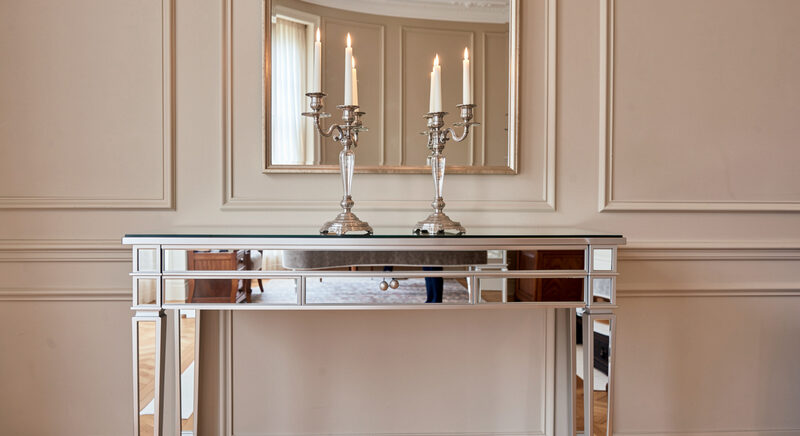
The mirror workshop did not stop at the wall. From the same bench came consoles, stools, chairs, cupboards and small tables faced in mirror glass, objects in which the reflective surface is applied to a piece of furniture rather than hung on a wall. Mirrored furniture is the most architectural product of the Venetian tradition, and it asks for a different way of thinking about weight, structure and care.
What mirrored furniture is
A mirrored console, stool or cupboard is built like any other piece of furniture, with a carcass of wood or a composite board, and then faced with panels of mirror glass. The glass may be plain, or it may be bevelled and engraved to match the vocabulary of a mirror frame. On a console table the top and the front are usually mirrored, so the piece reflects the floor and the room at once and seems to take up less space than it does. On a stool or a chair, the mirrored panels are smaller and the structure has to be strong enough to carry a person as well as the glass.
Why the workshop made it
The origin of mirrored furniture is partly practical. A mirror workshop cuts many pieces of glass, and offcuts of a useful size are inevitable. Facing a small table or a stool with these offcuts turns waste into a product and extends the vocabulary of the craft into three dimensions. The same decorative language, bevelled borders, applied flowers, coloured glass edges, appears on furniture as on a frame, which is why a mirrored console and a Venetian mirror from the same workshop look like a set.
The main forms
The console table is the most common piece, designed to stand against a wall in a hallway or behind a sofa, often with a mirrored top and a mirrored apron and legs. The mirrored stool is a small, light piece, useful as a side seat or as a stand for a lamp. Mirrored chairs are rarer and heavier, and they demand a strong frame because the seat has to bear weight. Cupboards and small cabinets faced in mirror glass are the least common, since the glass adds cost and weight without much benefit to storage, but they make a striking feature piece. A mirrored tray or a small mirrored side table sits between furniture and ornament.
How it is built
The carcass is made first, to the final dimensions, because the glass cannot be adjusted once it is cut. Panels of mirror glass are then cut to fit, edged and bevelled if required, and fixed to the carcass with an adhesive and often with small fixings hidden behind the joins. On a piece that will carry weight, the glass is not the structure: the wood underneath is. This is worth remembering when judging a piece, because a mirrored surface can hide a light or flimsy carcass, and the strength of the object depends entirely on what is under the glass.
Weight and movement
Mirrored furniture is heavy and it is rigid. That combination makes it awkward to move and unforgiving if it is dropped. Lifting a mirrored console by its top is a good way to crack the glass or pull a panel away from the carcass, because the glass is not designed to take a point load. Move it by the frame, keep it upright, and set it down gently. These precautions are the same ones that apply to a large wall mirror and are set out in the section on living with a mirror.
Where it works in a room
A mirrored console is at its best in a narrow space that needs more light: a hallway, a landing, a small dining room, or the space behind a sofa. Because it reflects the floor and the opposite wall, it makes a tight room feel larger and brighter without adding a light source. Mirrored stools and side tables work well in pairs, framing a sofa or a bed. The one rule worth keeping is restraint. A room with a mirrored console and a mirrored stool and a mirrored tray begins to look like a showroom, and the reflections compete rather than cooperate.
Care
The care of mirrored furniture is the care of a mirror, applied to a horizontal surface. Dust settles on a mirrored top and shows immediately, so it needs attention more often than a wall mirror. Clean with a soft cloth and a small amount of water or a mild glass cleaner applied to the cloth rather than sprayed onto the glass, and dry the surface afterwards so that no liquid runs down into the joints. The edges are the vulnerable part, as they are on any mirror, and the routine is described in the article on cleaning and caring for a mirror.
Buying and assessing a piece
Check the carcass first. Press gently on the top and the sides to feel for movement, and look underneath where the glass meets the frame for lifting panels and dark patches in the backing. Look along the edges of the mirror panels at an angle to the light, where foxing and edge damage show up first. Then consider the style, which follows the same family as wall mirrors: a console with a plain bevelled edge is the classic type, while one with coloured or applied glass belongs with the Murano style work. The construction of the glass itself is explained in the guide to the Venetian mirror. For the wider history of Venetian decorative arts, including the furniture and objects that grew from the glass trade, the encyclopaedia entry on Venetian glass is a helpful reference.