History and Origins
Murano Glass and the Mirror Makers
Why the glass furnaces moved to Murano, how cristallo was made, and how the island guild rules shaped the mirror trade for two hundred years.
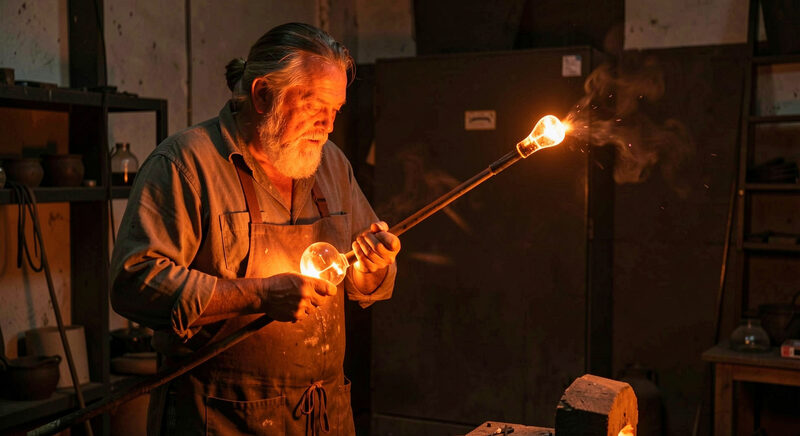
Murano is a small island in the Venetian lagoon, a short boat ride from the city, and for more than seven hundred years it has been the place where Venice made glass. Almost everything that makes a Venetian mirror possible was worked out there: a colourless glass clear enough to reflect, a way of joining it into a frame, and a set of workshop rules that kept the knowledge on the island for as long as the republic could manage.
Why the furnaces left Venice
Glassmaking is a fire trade. A furnace runs day and night, and in a city of timber houses and narrow lanes a single accident could destroy a district. By the end of the thirteenth century the Venetian authorities had ordered the glasshouses to move to Murano, and the island became an industrial quarter as well as a residential one. The move also made the trade easier to watch: workers, materials and finished goods all passed through a place the state could control.
What Murano had that others did not
The raw materials were ordinary enough. Sand, soda ash and lime, melted together and worked hot, will give you glass. The difficulty lay in purity. Soda ash imported from the eastern Mediterranean, together with careful selection of sand and a long apprenticeship in judging the melt by eye, produced a glass far less coloured and less cloudy than anything made north of the Alps. Murano did not invent glass, but it made glass that behaved like water.
Cristallo, the glass that could be a mirror
The breakthrough that made the mirror possible was a recipe known as cristallo, developed in the fifteenth century and associated with the Barovier family of glassmasters. Cristallo was almost colourless and unusually transparent, and it could be blown and worked into thin, even sheets. A mirror needs two things: a pane smooth enough that it does not scatter the light, and a backing that reflects. Cristallo supplied the first, and the tin and mercury amalgam that Murano's workshops perfected supplied the second. Put together, they made the Venetian mirror.
The guild and the secret
Murano's glassmakers organised themselves into a guild with its own statutes, its own officers and its own rules about who might set up a furnace and who might hire whom. Membership brought privileges that were remarkable for a craft: masters could carry arms, and their daughters could marry into the Venetian patriciate. The price of those privileges was loyalty. Glassmakers were forbidden to emigrate, and the republic treated the export of the mirror technique as a form of treason, pursuing defectors and, on occasion, ordering their assassination.
How the work was organised
A furnace was a small team rather than a factory. A master directed the melt and the blowing, assisted by servitors and apprentices who learned by watching and by doing the least skilled jobs for years. Specialists appeared for particular operations: one worker might do nothing but cut and bevel flat glass, another nothing but engrave the decoration, another prepare the silvering. That division of labour is still visible in the way a Venetian mirror is described today, as a sequence of stages rather than a single act of making. The sequence itself is set out in how a Venetian mirror is made.
What Murano made besides mirrors
Mirrors were only one product of the island. Murano supplied drinking glasses, beads, vessels, chandeliers and the coloured and enamelled glass for which it is still known. The decorative vocabulary that appears on Venetian frames, the scrolls, the leaves, the flowers and the twisted ribbons, was shared across all of these objects, which is why a mirror frame and a chandelier from the same period look like members of one family. The article on Murano style mirrors follows that vocabulary into the coloured glass work of later centuries.
Decline and revival
Murano's dominance did not survive the seventeenth century intact. Rival manufactories in France, Bohemia and England learned to make clear glass and, in some cases, made it better and cheaper. Venice lost the monopoly but kept the reputation. In the nineteenth and twentieth centuries the island reinvented itself around art glass, and the old techniques, including the making of mirror frames, were revived by workshops that trained new generations of masters. The furnaces that still work today are smaller and more specialised than the old glasshouses, and many of them depend on collectors, on museums and on visitors as much as on production for the table.
Reading a Murano frame today
When you look at a mirror described as Murano, you are usually looking for evidence of hand work: small variations in the glass, bubbles caught inside a blown piece, a slight irregularity where an engraved line changes direction. These are not faults so much as the signature of a hot process that no two hands perform in exactly the same way. The styles and forms section shows how that signature changes from the classic glass frame to the oval, the bubble and the mirrored console, and the page on finishes explains how the reflective surface on top of the glass is chosen.
The history of Murano glass, its guilds and its techniques, is set out in the encyclopaedia entry on Murano glass, which gathers the main dates and the principal families of makers in one place. For anyone buying or studying a Venetian mirror, it is a useful starting point before the object itself.