Care and Ownership
Packing and Shipping
How a glass framed mirror is packed in stages, why the corners matter most, and what a buyer should check when the crate is finally opened.
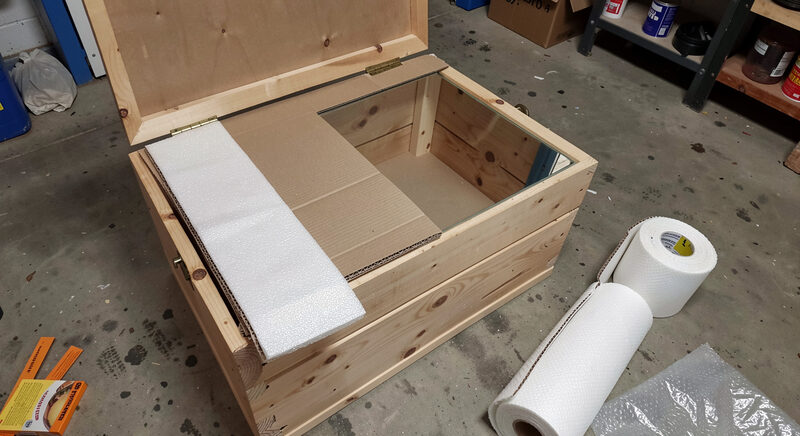
A Venetian mirror is one of the more difficult objects to move safely, because it is heavy, it is mostly glass, and its most vulnerable parts, the frame edges and the applied ornament, stick out where they can be struck. Packing a mirror is not a single act of wrapping but a sequence of stages, each one solving a different problem: the surface, the edges, the frame, the rigidity of the case, and the way the parcel is handled. Done in order, the sequence will get almost any mirror to its destination.
Stage one: protect the face
Start with the reflective surface. Cover the glass with a clean, soft material that will not scratch or leave fibres in the engraving, and then apply a protective film over that, taped only to itself or to the frame, never to the glass. The aim is to keep the surface from being touched, and to make sure that if the packing shifts, it is the padding that rubs and not the mirror. Do not use newspaper directly against glass, because the ink can transfer in damp conditions.
Stage two: the edges and corners
The corners of a mirror take the first impact in almost any accident, and on a Venetian frame the corners are also where the most fragile glass pieces meet. Fit a corner protector to each corner, in foam or in folded card, and then run a protective strip along every edge. This stage matters more than any other. A mirror can survive a knock on the flat face far more easily than a knock on a corner, where the energy is concentrated and the glass is thinnest.
Stage three: the frame and the ornament
The decorative elements of the frame, applied flowers, crests, bubbles and projecting scrolls, need their own padding so that they cannot be pressed against anything hard. Build up soft padding around the whole perimeter until the outline of the mirror is roughly rectangular and no single element sticks out. On a bubble frame, the domes are best protected by a layer of soft foam over the whole surface, held in place by an outer board, so that the pressure is spread rather than applied to individual domes.
Stage four: the rigid case
A soft parcel is not enough for a mirror. Once the mirror is padded, it needs a rigid outer layer, either a stout double walled cardboard case or, for a large or valuable piece, a wooden crate. The case should be big enough that the mirror does not touch the outer walls, with a layer of padding between the mirror and the case on every side. If a crate is used, the mirror should be fixed inside it so that it cannot move at all, because movement inside the case is what breaks glass, not the case itself.
Stage five: transport upright
A mirror travels upright, never flat. Laid flat, the whole weight of the frame bears on the glass, and any flexing cracks it. Upright, the mirror is in the position it was designed for, and the load runs through the frame rather than across the pane. This should be marked clearly on the outside of the case, with the words to keep upright and to handle with care, and repeated verbally to whoever carries it. A large crate should be strapped so that it cannot tip.
What the receiver should check
When a mirror arrives, do not open the case in a hurry or on a hard floor. Stand the case upright, open it where the mirror can be supported, and check in this order: the outer case for damage, then the padding for compression or staining that might indicate moisture, then the corners of the frame, then the flat glass at an angle to the light for cracks, and finally the reflective surface for new spotting or lifting. Photograph the case and the mirror before unpacking further, because a claim is much easier to support with pictures taken at the moment of opening.
Packing for storage rather than transport
A mirror that is going into storage for a long period needs slightly different treatment. It should stand upright on a padded surface, off a concrete floor, in a dry place, with the frame supported so that the weight is not on one corner. Wrap it so that dust cannot settle in the engraving, and check it occasionally for any sign of moisture or edge damage. Storing a mirror flat, or leaning it at an angle against a wall, is a reliable way to distort the frame or crack the glass over time.
When to use a specialist
For a large crowned mirror, a very valuable piece, or an antique with an aged reflective surface, it is worth paying a specialist fine art mover rather than packing it yourself. The cost is small compared with the cost of a broken frame, and the specialist will have custom crates, the right padding and insurance. If you do pack it yourself, the principles above still apply, and the general handling rules are set out in the section on living with a mirror. The way moisture and handling affect the reflective layer over time is described in the Williamstown Art Conservation Center paper on historic mercury amalgam mirrors: Historic Mercury Amalgam Mirrors. The construction of the mirror itself, which explains why it must travel upright, is in the guide to the Venetian mirror.