Styles and Forms
Bubble Mirrors
The bubble mirror is built from glass domes and discs, a later reading of the Venetian frame that changes shape with the angle of the light.
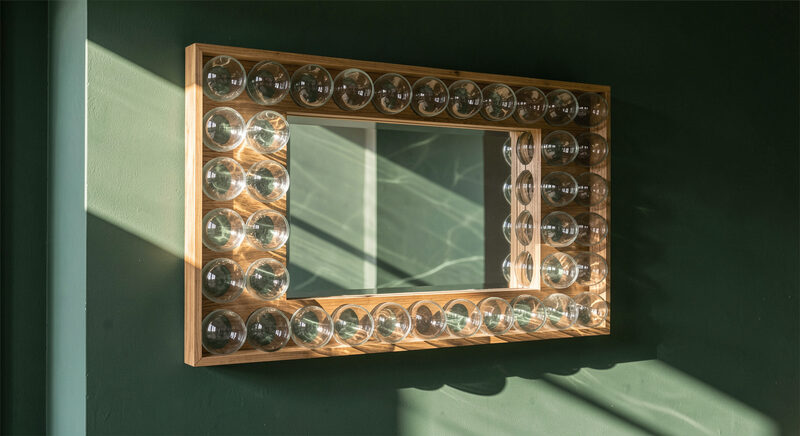
A bubble mirror replaces the flat glass border of a classic Venetian frame with rows of small blown domes. Instead of bevelled strips meeting at neat corners, the frame is a field of glass bubbles, each one a tiny sphere or disc that catches a point of light. The construction is still Venetian in spirit, a frame of glass around a pane, but the effect is quite different: a bubble frame reads as texture first and structure second, and it changes continuously as you move past it.
What the frame is made of
Each bubble is a small piece of blown glass, usually a dome or a disc, fixed to the backing structure in rows. The domes vary in size from a few millimetres to a couple of centimetres across, and the size decides the character of the whole piece. Small, tightly packed domes give a fine, almost beaded surface. Larger, more widely spaced domes give a bolder, more sculptural frame. Because the pieces are blown rather than cut, they are not identical, and the slight differences in height and curvature are what make the surface shimmer. Some makers mix sizes in a single frame, using larger domes at the corners and smaller ones along the sides, which gives the border a sense of movement and marks the corners as clearly as a bevelled join would.
How it behaves in light
A flat bevel throws light back in one direction. A dome gathers light from many directions at once and concentrates it into a bright point, so a bubble frame under a side light becomes a field of small highlights rather than a continuous bright line. Move your head and the highlights move with you. This is why bubble mirrors are often hung where they will be lit from the side, beside a window or under a picture light, and why they can look disappointing on a wall with flat, even light and nothing to reflect.
Where the style comes from
Bubble glass is part of the wider Murano vocabulary. Blown glass domes and discs were used on vessels, lamps and decorative objects long before they were applied to mirror frames, and the bubble mirror is best understood as a later reading of the Venetian frame rather than an ancient type. It belongs to the period when Venetian workshops, having lost their technical monopoly, turned to inventiveness and to the revival of old techniques, producing frames that were more decorative and more varied than the formal classic. The wider story is in the history section and in the article on Murano glass.
Clear, coloured and mixed frames
Most bubble frames are made in clear crystal glass, which keeps the effect light and lets the bubbles read purely as points of light. Coloured bubbles, especially amber and gold, warm the whole frame and can make a large mirror feel less cold in a dark room. Mixed frames, where clear and coloured domes alternate in a pattern, add a second layer of interest but demand more discipline from the maker, since the pattern has to be maintained across the whole border. The colour options are the same as those used on other Murano style work, described in the article on Murano style mirrors.
Telling a good frame from a poor one
Look at the bubbles individually and then as a group. Individually, a good dome is smooth, evenly blown and firmly fixed, with no sharp edges where it meets the backing. As a group, the rows should be regular without being mechanical, and the domes should sit at a consistent height so that the surface does not look dented. A frame where some domes are loose, cracked or clearly different in size from their neighbours will not age well, because a single broken bubble is difficult to replace invisibly.
Hanging and weight
Bubble frames can be surprisingly heavy, because every dome adds glass, and the weight is spread across a surface that is mostly empty. The backing structure has to be rigid, and the hanging point has to be strong. As with any glass framed mirror, fix into the structure of the wall rather than the plaster, and consider a batten for anything large. The practical notes are gathered in sizes and placement and in the section on living with a mirror.
Care
Bubble frames collect dust in the gaps between the domes, and those gaps are exactly where a cloth cannot easily reach. The safest approach is a soft brush, the kind used for camera lenses or for dusting ornaments, worked gently across the surface, followed by a dry cloth on the flat glass of the pane. Never soak a bubble frame or spray cleaner directly onto it, because liquid that runs behind the domes can reach the backing and start the edge damage described in the article on care.
Choosing a bubble mirror
A bubble mirror is at its best as a single statement piece on a wall that does not already have much pattern. Because the frame is busy, it competes with wallpaper, panelling and other ornament, and it works better against a plain painted surface. It suits both traditional and modern interiors, which is unusual for a Venetian type, and it is a good choice for someone who wants the glass frame tradition without the formality of a crowned mirror. The other shapes in the family are set out in the styles section. For the wider craft behind blown glass ornament, the encyclopaedia entry on Murano glass is a useful background reference.