Styles and Forms
Venetian Mirror Styles
A guide to the main shapes of the Venetian mirror, from the crowned overmantel and the crest to the oval, the bubble and the mirrored console.
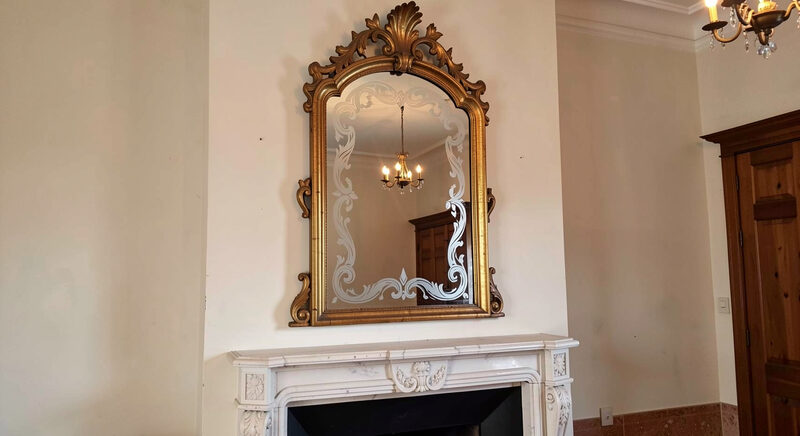
Venetian mirrors come in a small number of recognisable shapes, and the names for them are mostly borrowed from architecture and furniture. Knowing the family makes it much easier to describe what you are looking at, to search for a piece, or to explain to a dealer what you have in mind. The pages in this section take each of the main types in turn, from the tall crowned mirror that hangs above a fireplace to the console table faced in mirror glass.
The crowned mirror
The crowned mirror is the grandest member of the family. It is a tall rectangular mirror with an ornamental top, the crown, built up from glass scrolls, leaves or a crest, so that the whole object reads as a doorway or a window rather than a plain panel. Crowned mirrors were designed for overmantels, where the crown continues the line of the chimney breast upwards, and they are often the largest and heaviest pieces a workshop produces. Because the crown is made of separate glass pieces, it is also the most fragile part in transit.
The crest mirror
A crest mirror carries its ornament on top but is smaller and shallower than a full crowned mirror. The crest is a compact decorative group, sometimes a shell, a plume or a small arrangement of flowers and scrolls, set above a rectangular or arched pane. Crest mirrors suit hallways and narrow walls, where a large crowned mirror would overwhelm the space, and they are often hung in pairs.
The oval
The oval Venetian mirror softens the geometry of the type. The central pane is oval or round, and the frame follows the curve, built from short bevelled pieces and small rosettes. Ovals are often decorated with applied glass flowers and leaves, and their curved borders give a very different play of light from a straight edge, because the bevels run in many directions at once. A round or oval mirror is a good choice where a rectangular frame would look institutional, and it works well above a sideboard or a small mantel.
The bubble frame
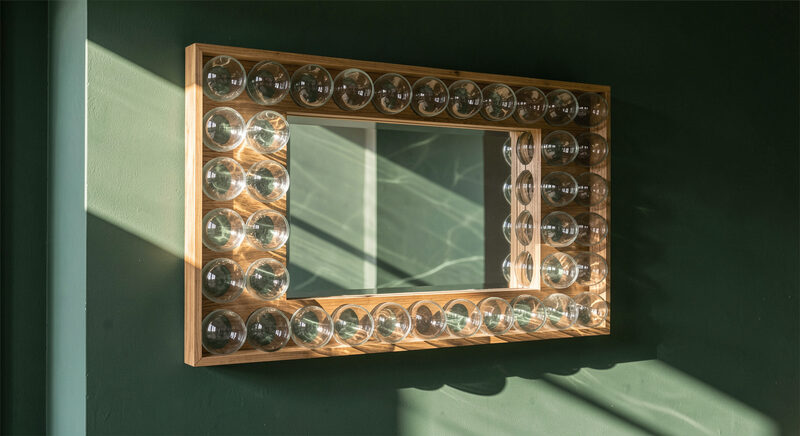
The bubble mirror is built from glass domes and discs instead of flat strips. Rows of small blown domes are fixed around the pane, and because each dome is curved, it catches a point of light and holds it. Bubble frames are a later development within the Venetian vocabulary, and they can look either antique or entirely modern depending on the size of the domes and the finish of the glass. They are described in more detail in the article on bubble mirrors.
Coloured and Murano style frames
Within every shape there is a choice of glass. A frame may be built in clear crystal, or in amber, aquamarine, blue, green or smoked glass, sometimes with gold leaf sealed inside the layers and with applied flowers in several colours. These coloured frames are usually grouped under the name Murano style, and they change the mood of a room completely, because the frame itself becomes a source of warm or cool colour rather than a neutral border. The range is set out in the article on Murano style mirrors.
Mirrored furniture
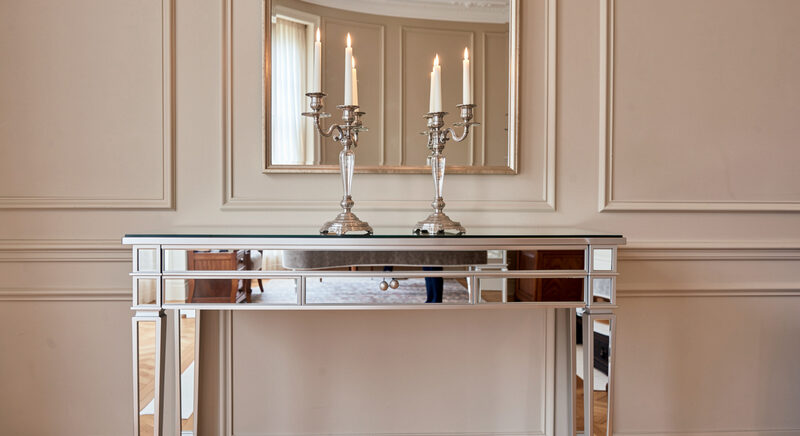
The same workshop that made wall mirrors also faced furniture in mirror glass. Consoles, stools, chairs, cupboards and small tables were built with mirrored surfaces, so that a piece of furniture doubled as a reflector and seemed to dissolve into the room. Mirrored furniture is closer to cabinetry than to wall hanging, and it raises its own questions about weight, structure and care. The main forms are described in the article on mirrored furniture.
Sconces, trays and small pieces
Beyond mirrors and furniture, Venetian workshops produced small objects in the same language: wall sconces that hold candles or a light, mirrored trays, and decorative panels. These pieces are useful to a collector because they show the vocabulary of the craft at a smaller scale and at a lower price, and they often reveal how a frame was assembled, since the backs are easier to inspect than on a large mirror.
How to choose a shape
The choice is mostly a matter of proportion. A tall crowned mirror needs a tall wall and a strong vertical line to anchor, such as a fireplace or a panelled section. A crest mirror suits a narrow wall or a pair of matching spots. An oval or round mirror softens a room full of straight edges. A bubble frame adds texture to a plain wall and works well in both traditional and modern interiors. Mirrored furniture is best used sparingly, as one piece rather than a set, so that the reflections do not compete with one another.
Reading the construction
Whatever the shape, the underlying construction is the same, and the guide to the Venetian mirror explains how the frame, the bevel and the rosettes fit together. The workshop that produces these shapes is described in the craft section, and the finish on the glass is covered in the article on finishes. A museum example of how nineteenth and twentieth century workshops revived the traditional Venetian style, sometimes copying historic pieces closely, can be seen in the V&A collection record for a Murano glass goblet: Goblet, Venice and Murano Glass Company. It is a useful reminder that the Venetian style has been revived, copied and reinterpreted for well over a century.
Styles and Forms
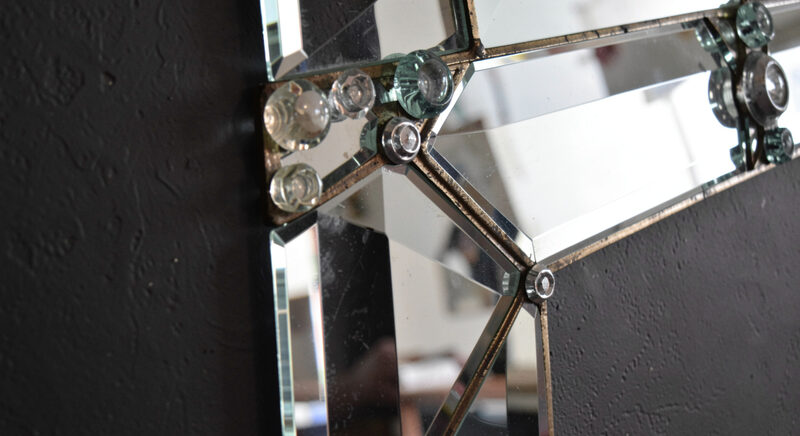
The Venetian Mirror
Why the Venetian mirror is built as a frame of glass rather than wood, how the bevelled border throws light, and what to look at first.
Why the frame itself is made of glass, and what to look at first.
Styles and Forms
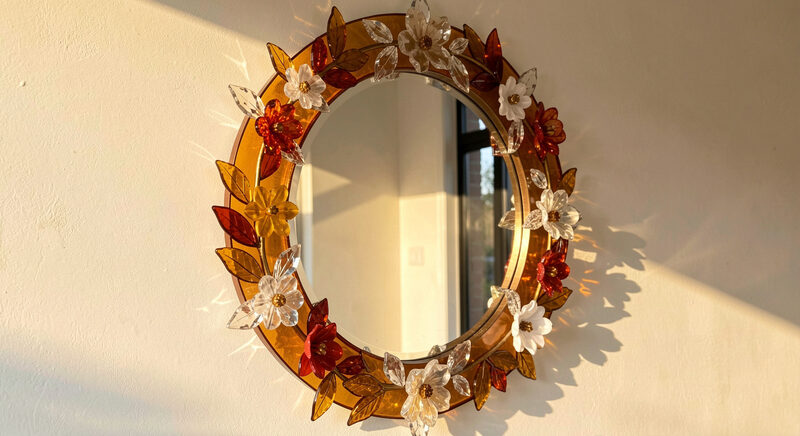
Murano Style Mirrors
How Murano style mirrors use coloured and crystal glass, gold leaf and applied flowers, and how they differ from a classic Venetian mirror.
Coloured glass, gold leaf and applied flowers in the frame.
Styles and Forms
Bubble Mirrors
The bubble mirror is built from glass domes and discs, a later reading of the Venetian frame that changes shape with the angle of the light.
A border of blown domes that gathers light into points.
Styles and Forms
Mirrored Furniture
Console tables, stools, chairs and cupboards faced in mirror glass, the furniture that grew out of the Venetian mirror workshop and its offcuts.
Consoles, stools and cupboards faced in mirror glass.