Craft and Making
The Craft of the Venetian Mirror
The workshop behind a Venetian mirror: the tools, the order of the stages, the engraver's skill and the finishing that decides the final look.
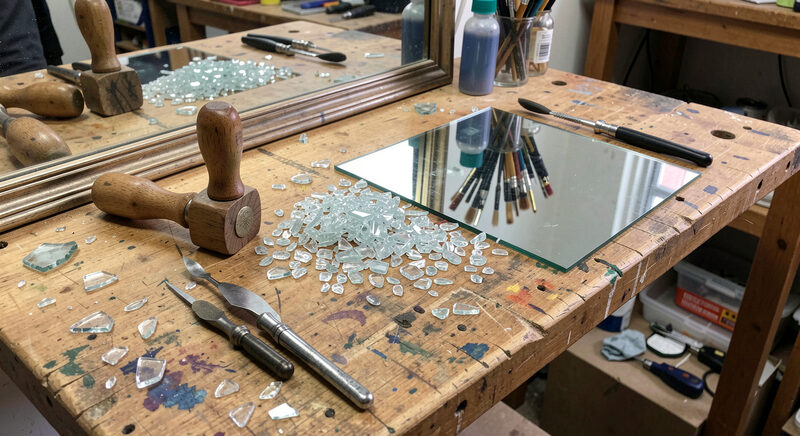
A Venetian mirror is made at a bench, by hand, with a small number of tools that have changed remarkably little since the sixteenth century. What follows is an introduction to that workshop: the tools on the bench, the order in which they are used, and the two skills, cutting and engraving, that decide whether a mirror looks like a machine product or like a piece of glass work.
The bench and its tools
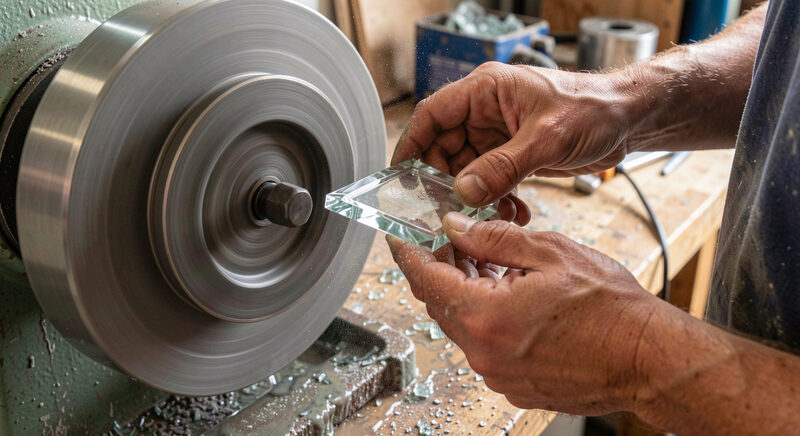
The core tool is a wheel. Flat glass is shaped and decorated with rotating wheels of different materials: coarse stones for rough shaping, finer stones for smoothing, and polishing wheels charged with a fine abrasive for bringing up the surface. A diamond tipped cutter scores a line so that a sheet can be broken cleanly. Alongside these sit wooden mallets, clamps, a shallow trough of water to keep the glass cool, and the small glass pieces, rosettes and strips that will become the frame. Nothing on the bench is complicated. The skill is in the hand that holds the glass against the wheel.
Why the order matters
Glass is unforgiving. A mistake made at the cutting stage cannot be undone later, and a piece that is engraved before it is bevelled will lose part of its decoration when the edge is ground down. The sequence therefore runs from the general to the particular: first the shape of each piece, then its edges, then its surface decoration, then the reflective backing, and finally the assembly of the frame. Reversing two steps does not merely spoil the look, it can break the piece.
The two decisive skills
Cutting decides the outline of every element in the frame, from a long straight border to a small leaf. Bevelling decides how the light behaves at the edge of each piece. A bevel is a sloping facet ground along the border of a glass panel, and it works like a prism: it catches light from the room and throws it back as a bright line. This is why a Venetian mirror seems to glow at its borders even in a dim room. The second skill is engraving, where a fine wheel is drawn across the surface to cut a shallow line. By varying the pressure, the angle and the direction of the pass, an engraver builds up floral scrolls, vines, leaves and ribbons with no drawing to copy, working from memory and from the marks already on the glass.
Faceting and the sparkle
Faceting is the cutting of small flat planes, one at a time, along the edge or across the surface of a piece. Each facet acts as a tiny mirror at a different angle, so a faceted border breaks a single reflection into a row of highlights. This is the stage that most clearly separates a hand made Venetian frame from a moulded imitation, because the facets are cut individually and never line up with perfect regularity. That slight irregularity is the source of the mirror's liveliness.
Silvering, the invisible stage
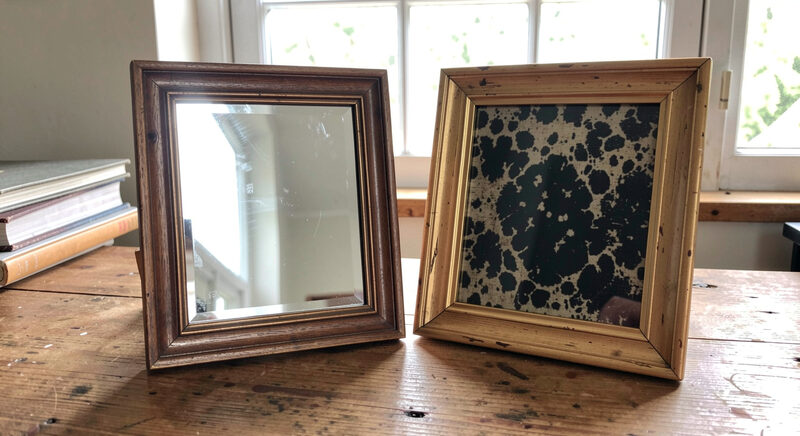
After the glass is shaped and decorated, it must be made reflective. The traditional method applies a thin layer of metal to the back of the glass and seals it. The quality of the silvering decides how deep and how neutral the reflection appears, and it is the stage that ages most visibly, because the backing can oxidise, spot or lift away from the glass over decades. The different approaches, from a bright modern silvering to a deliberately aged surface, are compared in the article on finishes.
Assembly and the rosettes
The frame is built from separate pieces of glass, not from a single sheet. Borders, corner pieces, crests and small applied flowers are joined to a backing structure and to one another, often with small glass discs or rosettes that hide the fixing and double as ornament. Assembly is the stage where the mirror becomes an object rather than a set of parts, and where the maker decides how much of the glass will sit proud of the frame and catch a side light.
How long it takes
A workshop will not quote a single figure, because the time depends on the design. A simple rectangular frame with plain bevelled borders moves quickly. A large crowned mirror with engraved scrolls, applied flowers and a faceted border can occupy a small team for days or weeks, since every decorative piece is cut, bevelled, engraved and polished before it is fixed in place. The common description of a Venetian mirror as slow work is accurate, but the slowness is distributed across many small operations rather than concentrated in one heroic effort. A workshop will usually give a range rather than a promise, and it will build in time for a piece to be remade if a stage goes wrong, because glass does not allow second attempts on the same element.
Where to go next
The full sequence, step by step, is set out in how a Venetian mirror is made. The guide to the Venetian mirror explains how the finished object is read, the styles and forms section shows how the same craft produces different shapes, and the pages on owning a mirror deal with what happens after it leaves the bench.
For a clear account of how the reflective surface itself developed, from early glass to the metal coatings used on mirrors today, the Smithsonian design museum's essay on light and mirrors is a good companion to this page: Reflections on Light.
Craft and Making
How a Venetian Mirror Is Made
From cutting and bevelling to faceting, engraving and silvering, a plain account of the stages an artisan works through to finish a mirror.
Eleven stages, from the template on paper to the inspection in daylight.
Craft and Making
Silvered and Antique Finishes
What separates a bright silvered finish from an antique one, how colour enters the glass, and how each finish ages in a real room over the years.
Bright silvering, deliberate patina and colour in the glass.