Craft and Making
How a Venetian Mirror Is Made
From cutting and bevelling to faceting, engraving and silvering, a plain account of the stages an artisan works through to finish a mirror.
Every Venetian mirror is a small engineering problem dressed as ornament. The maker has to produce a frame out of glass, join its pieces so that they hold, decorate the surface, and then make the whole thing reflective without spoiling any of the work already done. The order below is the order a traditional workshop follows. Different ateliers group the steps differently, and a simple design may skip several, but the logic does not change: shape first, decoration second, reflection third, assembly last.
1. Design and template
Work begins on paper. The overall size is set, the proportions of the frame are drawn, and the decorative elements, scrolls, leaves, crests and rosettes, are laid out around the central pane. From the drawing a template is made, often in card or thin wood, so that each glass piece can be marked and checked against the design. The template is what makes a mirror repeatable: two mirrors from the same pattern will match, while the hand work inside each piece keeps them from being identical.
2. Cutting the glass
The pane and the frame pieces are cut from flat glass. A cutter scores the surface along a straight edge, and the sheet is broken along the score. Curved elements are roughed out slightly larger than the finished shape, because the grinding stages that follow will remove material from every edge. At this point the pieces are still sharp and dull, and the mirror exists only as a plan on the bench.
3. Shaping and grinding
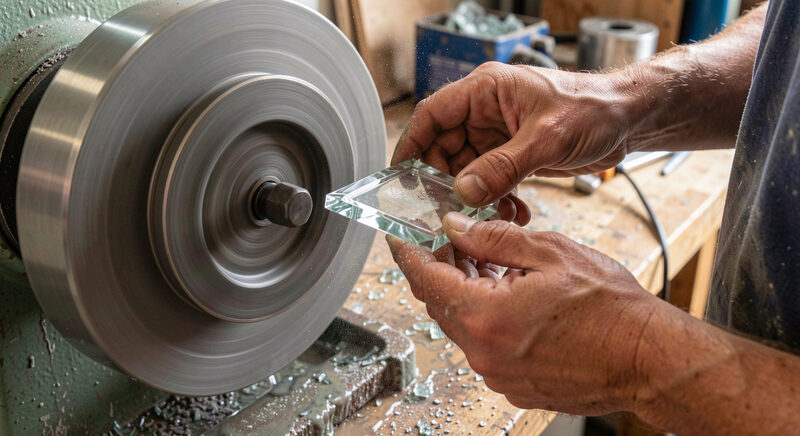
Each piece is pressed against a rotating wheel to bring it to its final outline. Coarse wheels remove the bulk of the material quickly and leave a frosted edge. The worker keeps a trough of water at hand, both to cool the glass and to wash away the fine dust that would otherwise scratch the surface. This stage is repetitive and demands a steady hand, since an over eager pass can chip a corner and send the piece back to the cutter.
4. Bevelling
A bevel is a sloping facet ground along the border of a piece, usually at an angle of about twenty to forty five degrees. It is cut on a wheel and then smoothed and polished in the same way as the flat surface. The bevel is not only decorative: it refracts light from the room and returns it as a bright edge, which is why a bevelled frame appears to be lit from within. Getting the angle consistent across many pieces is one of the marks of a good workshop.
5. Faceting
Faceting goes further than bevelling. Instead of one continuous slope, the maker cuts a series of small flat planes, each at a slightly different angle, often in a row along a border or across the face of an element. Each facet acts as a miniature mirror, so a faceted strip breaks a reflection into a line of separate highlights. The facets are cut one at a time and polished individually, which is why the sparkle of a hand cut frame looks irregular and alive rather than even and mechanical.
6. Engraving
Engraving is the drawing stage of the craft. Using a fine wheel, the engraver cuts shallow lines into the surface of the glass, building up flowers, leaves, vines and scrolls. There is usually no pencil drawing underneath: the design is carried in the hand and in the pattern of the piece. The depth of the cut is controlled by pressure, and the line is built up in several passes, because trying to cut too deep in one go risks cracking the glass or leaving a ragged edge. This is the slowest and most personal part of the work.
7. Polishing
Every cut surface, whether it is an edge, a bevel or an engraved line, is polished back to transparency. Polishing is done with progressively finer abrasives on soft wheels, and it is the stage that removes the grey, frosted look left by grinding. A well polished engraved line reads as a bright groove in the glass; a poorly polished one stays milky and dulls the whole piece.
8. Silvering
The glass is now ready to become a mirror. The traditional method deposits a thin layer of metal on the back of the pane and then seals it against air and moisture. The backing is what turns a clear sheet into a reflective surface, and its quality decides how bright, how neutral and how durable the reflection will be. Modern workshops have replaced the historic mercury amalgam with safer processes, but the aim is unchanged: an even coating, free of spots, that will not lift from the glass. The choice between a bright and an aged surface is discussed in the article on finishes.
9. Building the frame
In parallel with the glass work, the backing structure of the mirror is prepared. This is the hidden part that carries the weight: a wooden or composite body to which the glass pieces will be fixed. It is sized so that the decorative pieces overlap the edges of the pane and so that the whole object can be hung safely. A large Venetian mirror is heavy, and the frame must distribute that weight without flexing, because flexing glass cracks.
10. Assembly and rosettes
The pieces are fixed to the frame in a deliberate order, usually from the centre outwards, so that each element can be adjusted against the ones already in place. Small glass discs, called rosettes, are used both to cover the fixings and to add another point of reflected light. Assembly is where the mirror finally appears as a single object, and it is also the last chance to correct a piece that does not sit true.
11. Finishing and inspection
At the end the maker checks the mirror in daylight and under a raking light, looking for scratches, cloudy patches, uneven bevels and any piece that sits proud of its neighbours. The frame is cleaned, the hanging fittings are attached, and the mirror is recorded, measured and wrapped. A finished piece is judged as a whole rather than piece by piece, because the effect of a Venetian mirror comes from the way many small reflective surfaces work together.
Where the work is explained further
The tools and the skills behind these stages are introduced in the article on Venetian mirror craft, and the finished object is read in the guide to the Venetian mirror. Buyers who want to understand what they are looking at before they commit can start with the styles and forms section. A museum account of how mirrors reflect light, from the first glass surfaces to modern coatings, is available in the Corning Museum of Glass essay on the subject: Stories in Reflection.