Craft and Making
Silvered and Antique Finishes
What separates a bright silvered finish from an antique one, how colour enters the glass, and how each finish ages in a real room over the years.
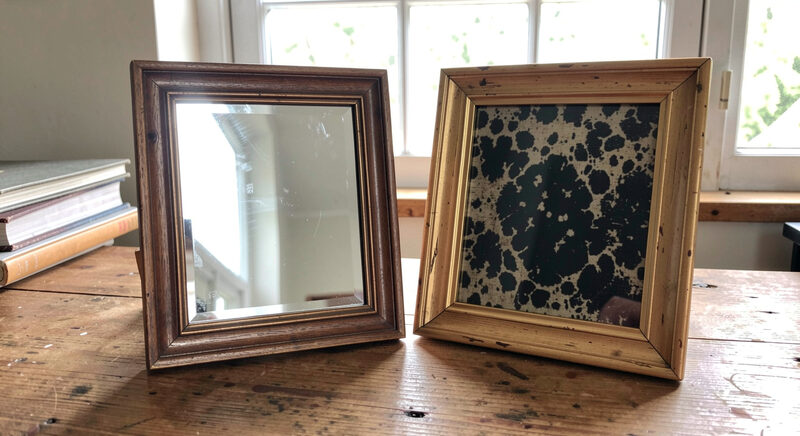
The reflection in a mirror is made by a thin layer of metal sitting behind the glass. Everything a buyer calls the finish, whether a mirror looks bright and new or dark and spotted, comes down to that layer: what metal is used, how evenly it is laid down, how it is sealed, and how it has aged since. Two mirrors can be cut from the same glass, in the same workshop, and look a century apart simply because of the backing.
What a silvered finish is
Silvering is the traditional name for the process that coats the back of a pane with a reflective metal layer and seals it. Historically the metal was applied as a tin and mercury amalgam, a method that gave a deep and slightly warm reflection but was dangerous to the people who worked with it. Modern workshops use safer chemical processes that deposit a bright, neutral layer of silver or a silver substitute. A good silvering is even across the whole pane, free of clouds and spots, and bonded firmly to the glass so that it does not lift at the edges.
Why a bright finish is not the same as a cheap one
It is easy to assume that a dark, mottled mirror is old and therefore valuable, and that a bright one is new and ordinary. That is only sometimes true. A bright silvered finish can be the mark of careful work, and it is the correct choice for a mirror meant to light a room, to sit opposite a window, or to hang where its reflection will be used. The brightness of the finish has more to do with the intended effect than with the age or the quality of the piece.
What an antique finish actually is
An antique finish is a deliberate decision to make the reflective surface look aged. The backing is worked so that it appears mottled, cloudy or darkened in patches, sometimes with a warm brown or grey tone, so that the mirror reads as an older object and its reflection is softened rather than sharp. In most cases the effect is created on purpose in the workshop, using treated backings or controlled ageing, rather than waited for over decades. This is worth knowing before paying a premium for what is presented as natural age: a genuine century of foxing looks different from a manufactured patina, and the two are not priced the same way.
The clues that separate the two, from the metal of the backing to the place where the spots gather, are brought together in the guide to dating an antique Venetian mirror.
How real mirrors age
Left to itself, a mirror ages from the edges inwards. Moisture creeps behind the glass, the backing begins to oxidise, and small dark spots appear, a condition often called foxing. In damp rooms, or in coastal air, the process is faster, and it can lift the backing in patches that look like clouds under the surface. Sunlight fades the reflective layer slowly and can discolour an old frame. None of this is reversible: once the backing has lifted, the metal cannot be put back evenly, and re silvering an antique mirror destroys the very surface that made it interesting.
Colour in the glass
The other dimension of finish is colour, and here the colour is usually in the glass itself rather than in the backing. Murano workshops produced glass in amber, aquamarine, blue, green, gold and smoked tones, and these coloured pieces are used to build frames and applied decoration. Gold leaf, sealed between layers of glass, gives a warm metallic tone that does not tarnish. A frame in coloured glass changes the character of a mirror entirely: a clear frame throws light, while an amber or gold frame warms the room and softens the edges of the reflection. The way these coloured frames are built is described in the article on Murano style mirrors.
Choosing a finish for a room
The practical question is where the mirror will hang. In a bright room facing a window, a clear silvered finish makes the most of the available light and can make a small space feel larger. In a darker or warmer interior, an antique finish or a coloured frame can stop the mirror from reading as a hard, cold rectangle, because a softened reflection is less insistent. A gold or amber frame against a dark wall gives a strong warm accent, while a smoked or grey finish suits a cooler, quieter scheme.
Looking after a finish
Whatever the finish, the enemy is moisture at the edges. Keeping a mirror away from damp walls, avoiding sprays that run down the glass into the frame, and drying the surface after cleaning all extend the life of the backing. The full routine, including what not to use near the edges, is set out in the article on cleaning and caring for a mirror.
How to compare two mirrors
When comparing finishes, look at the glass at an angle to the light, not straight on. Straight on, almost any mirror looks even. At an angle, clouds, spots and uneven patches show themselves, and you can see whether a patina is spread evenly across the surface or concentrated in a way that suggests real age. The overall shape and construction are covered in the guide to the Venetian mirror, and the workshop stage that produces the backing is described in how a Venetian mirror is made.
A useful technical reference on how historic mirrors were made and how their reflective layer deteriorates is the Williamstown Art Conservation Center paper on mercury amalgam mirrors: Historic Mercury Amalgam Mirrors. It is a reminder that the surface we take for granted is a manufactured layer, and that its condition is part of what we are buying.