Care and Ownership
Sizes and Placement
How to read the height and width of a Venetian mirror, where each size belongs, and how to check a wall before you hang a heavy glass frame.
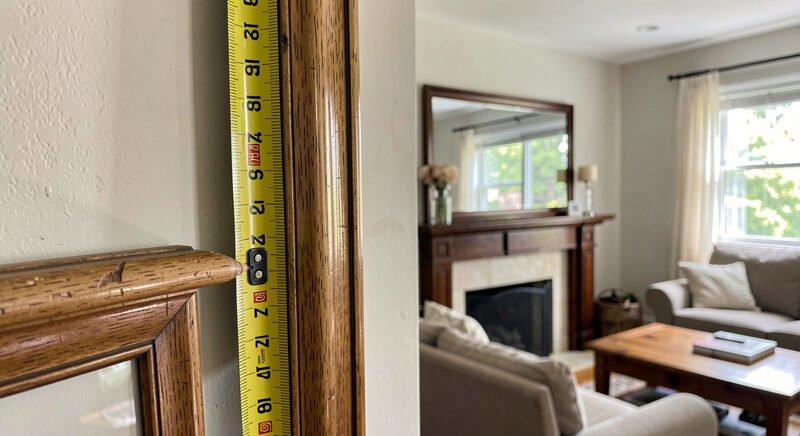
A mirror is sold by its height and its width, and a Venetian mirror is usually quoted with the height first, because the type is a vertical object. Getting the size right is less about fashion than about proportion: a mirror that is too small for its wall looks lost, one that is too large crowds the room, and one hung at the wrong height is uncomfortable to use no matter how beautiful it is. The notes below cover how to read a size, where each size belongs, and how to prepare a wall before anything is lifted.
How a size is written
Sizes are given as height by width, in inches or in centimetres, and sometimes both. A mirror described as 60 by 24 inches is five feet tall and two feet wide, a tall and narrow proportion typical of a crest or a slender overmantel. A mirror of 42.5 by 42.5 inches is square, a proportion that suits a round or square design. When a frame is built from glass, the stated size usually includes the frame, not just the central pane, so the reflective area is smaller than the overall figure. If the pane size matters to you, ask for it separately.
Common sizes and where they belong
Small mirrors, up to about 30 inches tall, suit hallways, bathrooms, small bedrooms and the space above a side table or a basin. Medium mirrors, from about 30 to 50 inches, are the workhorses of a house: above a chest of drawers, a sideboard, a fireplace in a modest room, or in a bedroom where a full length view is not needed. Large mirrors, from about 50 inches upwards, are overmantel and statement pieces. They need a tall wall, a strong vertical line to anchor them, and enough clear space in front that the reflection is not blocked by furniture.
Height on the wall
The traditional rule for a mirror used for looking at yourself is to set the centre of the glass at eye level, roughly 150 to 160 centimetres from the floor, or about five feet. The rule changes when the mirror is doing a decorative job. Above a fireplace, the mirror should sit on the mantel line and rise from it, with the bottom of the frame just clear of the shelf. Above a piece of furniture, leave a gap of a few inches so the mirror does not look glued to the piece, and align the width of the mirror with the width of the furniture beneath it, or a little narrower, so that the group reads as one.
Proportion and the room
A mirror should take up a sensible share of the wall it hangs on. As a rough guide, a mirror above a piece of furniture works well when its width is between two thirds and the full width of that piece. On a blank wall, the mirror should be large enough that it does not look like a postage stamp, which usually means at least a third of the wall's width for a decorative piece. In a narrow hallway, a tall, narrow mirror makes the space feel higher. In a low room, a horizontal mirror can make the wall feel wider, though a Venetian frame is more often vertical by design.
Pairs and groupings
Two matching mirrors hung side by side, or one above another, can solve a wall that is too wide or too tall for a single piece. Pairs work best with crest mirrors or small ovals, where the design is compact and repeatable, and where two identical frames do not compete. Keep the spacing between a pair equal to about half the width of one mirror, so that they read as a pair rather than as two unrelated objects.
Preparing the wall
Before buying, find out what the wall is made of. Plasterboard on timber studs will take a mirror hung on a batten fixed across two studs, but not a single screw into the board alone. Solid masonry, brick or stone will take a heavy fixing directly, with the right plug and screw for the material. Old lath and plaster walls are deceptive, because they feel solid but hold very little. If in doubt, fix a batten across the wall and hang the mirror from that, and for a large Venetian mirror consider a professional installer, telling them the weight of the piece in advance.
Tools and the sequence
The job is straightforward if it is done in order: measure the mirror and the space, decide the height of the centre, mark it lightly in pencil, find the studs or the solid points, fit the batten or the fixings, then lift the mirror with two people, hook it on, and check it with a spirit level before letting go. Do not remove the protective wrapping until the mirror is on the wall, and keep the floor underneath padded while you work, because a dropped corner is the most expensive mistake in the whole process. The handling rules are repeated in the section on living with a mirror.
Size and the other choices
Size is one of four decisions a buyer makes, alongside shape, finish and colour. The shapes are set out in the styles section, the reflective surface in the article on finishes, and the construction that explains the weight in the guide to the Venetian mirror. For a general account of how mirrors are made and used, including the way a reflective surface is produced, the encyclopaedia entry on the mirror is a convenient reference.