History and Origins
How to Tell an Antique Venetian Mirror
The backing, the glass and the engraving each changed at a known date. How to tell a genuinely antique Venetian mirror from a later copy.
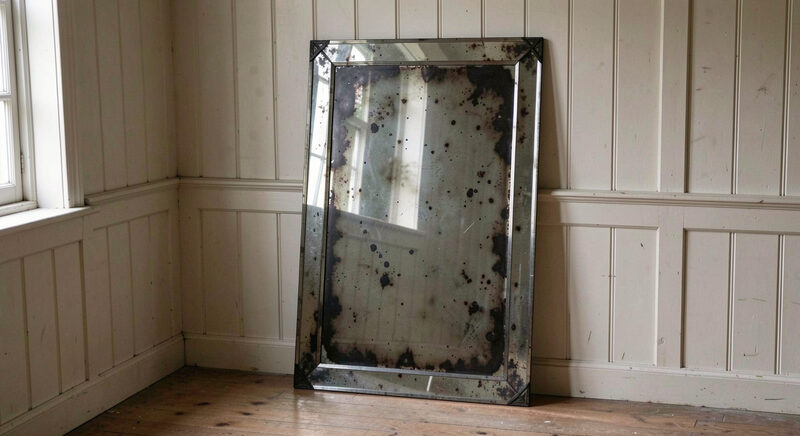
An antique Venetian mirror is dated by its materials rather than its style. Three things carry most of the evidence: the reflective layer behind the glass, the plate of glass itself, and the way the decoration was cut. Each of them changed at a known moment, from the tin and mercury backing used at Murano from the early sixteenth century to chemical silvering after 1835 and abrasive blasting after 1870, so each one narrows the range of dates a mirror can honestly claim. None of this replaces the eye of a conservator, but it is enough to separate a genuinely old mirror from a recent one dressed in an old style.
Why the style alone cannot date a mirror
The vocabulary of a Venetian mirror has hardly changed in centuries. A frame built from glass, bevelled borders, engraved flowers and small rosettes at the joins appear on pieces made long ago and on pieces made last year, and the style has been revived and copied for well over a century. A crown, a crest or an oval tells you which family a mirror belongs to, not when it was made. What changes over time is technique: the metal behind the glass, the way the glass was made, and the tools used to cut the ornament. Those traces are best read slowly, in good side light, with the mirror upright.
Is the backing tin and mercury, or silver?
The reflective layer is the strongest single clue. In the early sixteenth century the Del Gallo glassmakers of Murano developed a way of backing mirrors with an amalgam of tin and mercury. Tin foil was laid on a smooth stone table, usually marble, mercury was brushed over it until the tin dissolved, and the glass was lowered onto the result and weighted. The new mirror then spent eighteen to thirty days on a drying table, tilted a little more each day while the excess mercury drained away. The finished layer is roughly three parts tin to one part mercury, a bed of metal crystals with a liquid phase between them that never fully settles.
In 1835 the German chemist Justus von Liebig developed a way of depositing metallic silver on glass. The two methods existed side by side for a long time, and silvering only won out in the early twentieth century, so a nineteenth century mirror may have either backing.
Three observations help to tell them apart. Thin white paper held against the glass generally looks brighter over silver than over an amalgam. Silver tarnishes to a warm yellow brown, while a tin and mercury layer takes on the bluish tone of tin oxides. And silvered mirrors were almost always varnished or painted on the back, while amalgam mirrors were usually left bare unless they were made for damp rooms or for use at sea. The Williamstown Art Conservation Center sets out these tests in its paper on historic mercury amalgam mirrors.
What can the glass tell you?
The earliest mirror glass was blown into a cylinder, cut open and flattened, and a plate made that way was no larger than about four feet by two, roughly 1.2 by 0.6 metres. The casting method that arrived in the late seventeenth century produced plates of nearly nine feet by five. A single plate much larger than four feet by two therefore cannot belong to the earliest period, which is one reason early mirrors of any size were assembled from several smaller plates, with the joins hidden under decoration.
Plates were polished by hand until grinding and polishing machines were developed in the 1850s. Historic glass is generally thicker than modern glass and often slightly darker in tone, which gives an old reflection its softer, greyer cast. None of these points dates a mirror on its own, because a frame and its central plate do not always share a date, but read with the backing they narrow the range considerably.
How was the decoration cut?
The ornament of a traditional Venetian frame is engraved with a wheel. The engraver builds each line in several passes and controls its depth by pressure, so the cuts vary slightly in width and depth along their length. Two later techniques leave a different surface. Acid etching of glass developed in the middle of the nineteenth century, and abrasive blasting, which frosts glass with a jet of sand, was patented by Benjamin Chew Tilghman in 1870. Both give a matt, frosted area of even depth with no trace of a wheel, so a pattern with that look cannot be older than the mid nineteenth century, whatever the shape of the frame suggests.
What is it called when a mirror looks old?
When the reflective layer of a genuinely old mirror breaks down, the dark spots and cloudy patches are usually called foxing, and the loss of reflection itself is called desilvering. A mirror made to look old on purpose is a different object, sold as antiqued or antique mirror glass, a choice explained in the article on finishes that are aged on purpose. The phrase silvered glass adds a third meaning: hollow, double walled vases and ornaments silvered on the inside and often sold as mercury glass, made from the middle of the nineteenth century in Bohemia, England and the United States, as the encyclopaedia entry on silvered glass records.
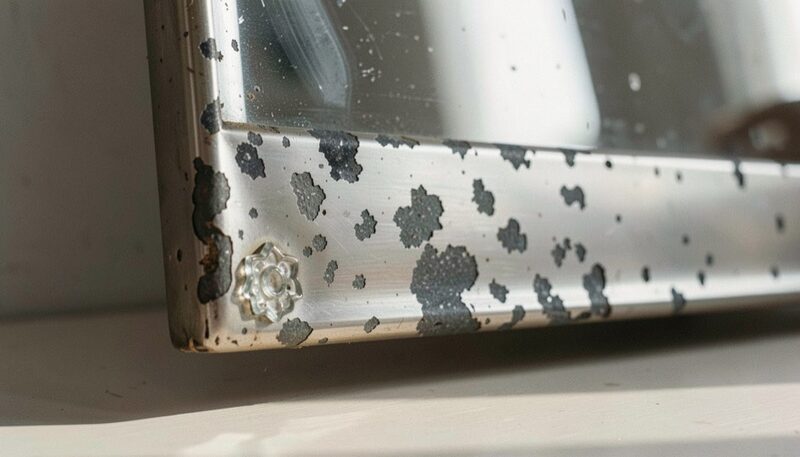
Real decay follows physics. Moisture reaches the metal from the edges, so a silvered mirror usually spots from its border inwards. In an amalgam mirror the liquid mercury slowly migrates downwards, which concentrates the damage in the lower half and leaves holes and a darkened, speckled surface where the metal crystals have grown apart. A patina spread evenly across the centre of a plate, with clean edges and an untouched lower border, deserves a second look before anyone pays for age.
Could a Venetian mirror really be from the sixteenth century?
It is possible, but the claim carries a heavy burden of proof. A mirror of that date would show every early sign at once: an amalgam backing, a plate no larger than the cylinder method allowed, thick and slightly dark glass, wheel cut decoration and the slow, downward decay of an amalgam. It would also have a documented past. A seller should be able to show its provenance, and an examination by a conservator or a museum specialist is the sensible step before any purchase. The period itself, from the cristallo of Murano to the guild that guarded the technique, is told in the history of the Venetian mirror.
An order of inspection
- Count the plates and estimate the size of the largest single piece of mirror glass.
- Compare a sheet of white paper on the glass with the same paper on a modern mirror.
- Look along the plate in side light: where do the spots gather, and what colour are they?
- Examine the engraving under raking light: varied wheel cuts, or a frosted pattern of even depth?
- Look at the back without opening it: paint or varnish over the metal, and any grey beads of metal along the lower edge of the frame.
Clues and the dates they point to
| What you see | What it suggests |
|---|---|
| Bare tin and mercury backing, bluish decay gathered low on the plate | The Murano method, used from the early sixteenth century and still common through the nineteenth |
| Painted or varnished silver backing, warm yellow brown tarnish | Made after 1835; silver replaced the amalgam entirely in the early twentieth century |
| A single plate much larger than four feet by two | Cast glass, available from the late seventeenth century |
| Wheel engraving that varies in width and depth | The traditional technique, used in every period and neutral on its own |
| Frosted decoration of perfectly even depth | Acid etching, from the mid nineteenth century, or abrasive blasting, patented in 1870 |
Handling a mirror that may contain mercury
An amalgam mirror is not a serious source of mercury vapour: when the Danish conservator Per Hadsund measured rooms lined from floor to ceiling with amalgam mirrors, he found levels well below accepted safety limits. The risk lies in liquid mercury, which can collect as beads at the bottom edge of the frame, between the glass and the backing board. The backing of a possible amalgam mirror should therefore stay closed unless a conservator opens it, dust from inside the frame should never be vacuumed, and the mirror is best handled with nitrile or vinyl gloves. Keep it in the orientation in which it has always hung, because turning it over floods the drier areas with mercury and causes further damage. The glass itself is cleaned with the slow, dry method described in the cleaning routine for an old mirror.
Three questions readers ask
Are old mercury mirrors dangerous to keep at home?
Not in normal use. Measurements in rooms lined with amalgam mirrors found mercury vapour well below safety limits. The precautions concern liquid mercury at the bottom of the frame: leave the back closed, never vacuum inside it, and call a conservator if beads of metal appear.
Does a dark, spotted mirror mean it is antique?
No. Spots can be a finish created in the workshop, or damp damage on a fairly recent silvered mirror. What matters is the pattern and the material: decay that starts at the edges or gathers at the bottom, and the bluish tone of tin and mercury or the yellow brown tarnish of old silver.
Should an antique Venetian mirror be re silvered?
Almost never. Re silvering removes the original reflective layer, the part of the object that carries its age. Conservators prefer to stabilise a failing surface with reversible treatments and to document their work, rather than make an old mirror look new.